I shipped the VisaNationals beta with a deliberately short guest list. Five countries — Nigeria, Pakistan, Ghana, Kenya and Bangladesh — the places where a refused UK visitor visa does the most quiet damage to ordinary families. Deep, localised, careful. That was the whole plan for launch week. Six days after going live on 5 July, I threw it out.
What changed my mind wasn't a strategy deck. It was the inbox. Within days, people were reaching for the check from countries I hadn't localised at all — and getting real value anyway, because the thing a UK entry-clearance decision turns on doesn't move with your passport. The rules are the rules. If the tool could tell a Nigerian applicant where they stood, it could tell anyone. Keeping the rest of the world out started to feel less like focus and more like a locked door for no reason.
So I opened it. VisaNationals now works for any nationality, anywhere. The original five stay deeply localised — their own languages, their own edge cases — and everyone else gets a clean, tailored run today, with more markets going deep over time. Widening this early is a risk. I'd rather take it than make someone in a sixth country guess.
Here is why those five came first, in one picture — and why the mission behind them didn't shrink when the map grew.
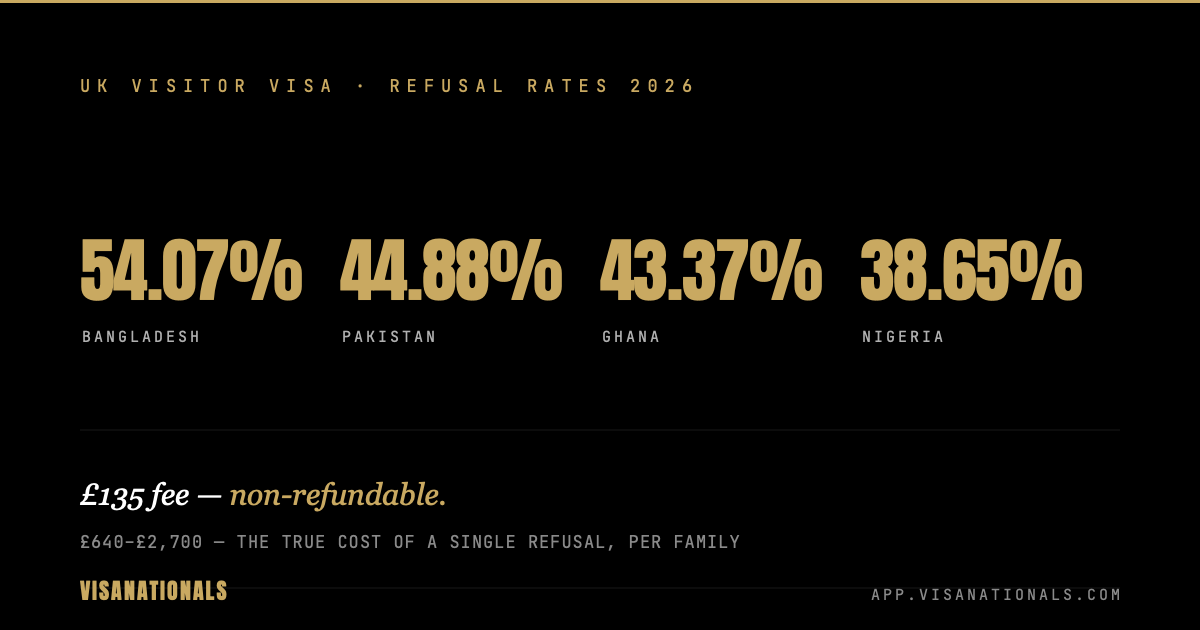
Read those figures slowly. In 2026 more than half of Bangladeshi applicants were turned away; for Pakistan, Ghana and Nigeria it sits between roughly two and four in ten. The £135 application fee is gone the moment a refusal lands — but the fee is the cheap part. Count the service charges, the certified documents, the flights and rooms booked on hope, and one refusal routinely sets a family back £640 to £2,700. Most of that loss was preventable, and almost nobody was ever shown how.
That is the whole point of the product, and it didn't change when I widened the map. VisaNationals looks at your case the way the people who actually decide it do, and tells you where you stand before you pay — every flag paired with the specific UK rule behind it and why it matters. It's free to run and takes about ten minutes. It will not promise you a visa; nothing honest can. Most refusals aren't dishonesty — they're people who never got to see their own application through the officer's eyes. This just hands them the mirror.
It's the same instinct behind everything I build — two passports taught me this: give people the means to move through a closed world without losing months, or money, to paperwork. A refusal is a signal, not a verdict — the tragedy is that almost no one can read it in time.
Status: live public beta, opened 5 July 2026 — the second of our six ventures to reach the public, after Amen.Travel.
Who it's for: any nationality, worldwide; deeply localised for Nigeria, Pakistan, Ghana, Kenya and Bangladesh.
Cost: the check is free and stays free. Optional deeper reports run $10 (Standard) and $20 (Premium) — but the free result is the reason it exists.
Now the ask, unchanged from day one: use it and tell me where it breaks. Open app.visanationals.com, run the check, and send me the question that confused you or the screen that didn't behave. It's early, and it will show. That is exactly why I want you in it now — from wherever in the world you're applying.
Try the check → app.visanationals.com
VisaNationals gives educational information only — it is not immigration legal advice and not a guarantee of a visa outcome. For regulated advice, consult an OISC-registered adviser. Refusal rates cited are drawn from published UK Home Office visa data. VisaNationals is operated by 3Men Pty Ltd (Australia · ABN 83 678 873 839).
← Back to Journal